
India's ambitious Mars Orbiter Mission will send a spacecraft hurtling into space on a 400-million-kilometre journey that will last a year. The blast off is on Tuesday afternoon.
In an exclusive commercial launch to be witnessed by Prime Minister Narendra Modi, India's national space agency ISRO is set to launch five satellites from four countries from the spaceport of Sriharikota.
India's Polar Satellite Launch vehicle-C16 rocket on Wednesday successfully launched into orbit the latest remote sensing satellite Resourcesat-2 that would study and help manage natural resources along with two nano satellites.
The BJP hit back accusing the Congress of drawing the issue into political arena.
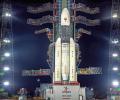
Late on Monday night, in a last-minute revision of schedule, ISRO announced that the launch of India's second lunar mission 'Chandrayaan-2' has been called off due to a technical snag.

Indian skipper Virat Kohli, on Monday, lauded ace sprinter Hima Das for winning five gold medals in a span of 20 days.
The satellite was placed at 4.18 pm, a little over 17 minutes after the Geosynchronous Satellite Launch Vehicle (GSLV-F-01) carrying it was launched from the Satish Dhawan Space Centre in Sriharikota.

The Indian space agency is all set to embark on its most complex mission.
Stage is set for the launch of PSLV-C9 from the Satish Dhawan Space Centre, Sriharikota. As many as ten satellites will be launched on Monday by the Indian Space Research Organisation, including country's latest remote sensing satellite and eight nano satellites.
India's top space scientists are analysing data to find out what caused the failure of Geosynchronous Satellite Launch Vehicle mission and an expert committee is likely to be formed soon to give a report on it.

Indian Space Research Organisation will announce a revised launch date later.

'The unique achievements have been made by engineers from small towns who have had a non elite upbringing and who have grown with the programme,' says R Aravamudan, one of the pioneers of the Indian space programme.

ISRO Chairman K Sivan said there might by a postponement if the weather was not conducive.
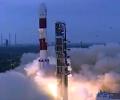
RESOURCESAT-2A, intended for resource monitoring, is a follow-on mission to RESOURCESAT-1 and RESOURCESAT-2, launched in 2003 and 2011 respectively. It is intended to continue the remote sensing data services to global users provided by RESOURCESAT-1 and 2.
Indian Space Research Organisation is all set for the launch of the first flight-testing of indigenous cryogenic engine on homespun rocket, Geosynchronous Satellite Launch Vehicle (GSLV-D3), from the Satish Dhawan Space Centre at Sriharikota at 4.27 pm on Thursday.
A round up of what's happening in the world of technology, gadgets and gizmos.
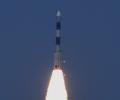
Prime Minister Narendra Modi lauded the scientists saying, "with this successful launch, we will determine our own paths powered by our technology".

In a boost for the country's surveillance capabilities to monitor activities of both military warships and merchant shipping in the Indian Ocean Region (IOR), the 'Sindhu Netra' satellite developed by a team of young scientists from Defence Research and Development Organisation (DRDO) was successfully deployed in space on Sunday.

The Rs 978 crore mission, which has been rescheduled for Monday after scientists corrected the glitch in the rocket, will be launched at 2.43 p.m from the second launchpad at Satish Dhawan Space Centre, over 100 km from Chennai.

PSLV C-29 blasted off from the Satish Dhawan Space Centre, about 110 km from Chennai, at 6 pm and released the six satellites one by one into a 550 km circular orbit.

The six satellites will be launched on PSLV-C29 from the Satish Dhawan Space Centre in Andhra Pradesh on December 16, 2015.

India's heavy-lift rocket GSLV MkIII, carrying communication satellite GSAT-19.

The 43.43 metre tall rocket lifted off at 5.28 pm from the second launch pad at the Satish Dhawan Space Centre in Sriharikota
India's first unmanned moon spacecraft, Chandrayaan-1 has entered the lunar transfer trajectory and is heading to an apogee of 3,80,000 KM as ISRO scientists on Tuesday carried the fifth and final orbit-raising manoeuvre.

'One remembers Professor Rao with fondness as the man who gave the space programme a very professional front face, a very different appearance from the raw energy of a Vikram Sarabhai or the polished passion of a Dr Satish Dhawan.'

Indian Space Research Organisation's Mars Orbiter, which was placed in inter-Mars trajectory in the early hours on Sunday, has crossed Moon's orbit and is travelling beyond Earth's natural satellite.
The satellite will enable a full range of services to neighbours including the areas of telecommunication, television, direct-to-home, VSATs, tele-education and tele-medicine.

India is the fourth country to demonstrate the flight testing of Scramjet Engine after the United States, Russia and European Space Agency.
ISRO said, initially the launch was slated for 9.49 am, but now there is a 3-minute delay owing to the probability of space debris in the path of rocket.
.jpg)
India's maiden mission to Mars has traversed beyond the sphere of influence of Earth extending about 9,25,000 km in its 10-month long voyage to the red planet.
ISRO has put out stunning photos of the launch of GSLV-D5. The vehicle smoothly lifted off to space from Sriharikota on Sunday afternoon and put India into the elite 'cryogenic club'.
Despite the odd time, hordes of enthusiasts had reached the island, some of them travelling long distances on two wheelers, to witness the historic moment.
The Indian Space Research Organisation said that the countdown started at 6.51 am on Sunday.

With the launch of GSLV-MK III, slated for April, it will be able to cater to bigger satellites as well.

The stage is set for the launch of India's satellite IRNSS-1D on Saturday from Sriharikota onboard workhorse PSLV-C27 that would pave the way for the country's own navigation system on par with the GPS of United States.

The success of the PSLV-C34 mission is a result of ISRO's professionalism and the hard work put in by their scientists over the last many decades., says Ajay Lele.

They made history for India and the world.

India's ambitious space mission to explore planet Mars would be launched on November 5 from the spaceport of Sriharikota, ISRO announced on Tuesday.

The launch of IRNSS IC, the third of seven satellites in the series to put in place India's navigation system at par with US' Global Positioning System, that was deferred following a technical snag has been rescheduled for October 16.
India's ambitious attempt to flight-test its indigenous cryogenic engine on Thursday received a setback as the homegrown rocket Geosynchronous Satellite Launch Vehicle (GSLV-D3) deviated from path within seconds of lift-off.
